How to Deploy AI Agents with GitOps and Safe Rollbacks
AI agents fail differently from ordinary web services. A release can pass every health check and still send the wrong email, corrupt a CRM record, or charge a card twice. GitOps gives one reviewed history for code, prompts, tools, and infrastructure, plus a rollback path that does not depend on memory.
What GitOps changes
GitOps is not a product. OpenGitOps defines four principles: desired state is declarative, versioned and immutable, pulled automatically, and continuously reconciled (OpenGitOps). A cluster controller such as Argo CD or Flux watches the repository and applies the difference.
The first benefit is fewer credentials. With Argo CD automated sync, the pipeline does not need direct cluster API access. It commits manifests, and the in-cluster controller syncs them (Argo CD automated sync). A compromised build system does not automatically become production access.
The second is a reviewable record. When an agent misbehaves, compare the running configuration with the previous commit instead of reconstructing events from chat logs. That shortens incidents and makes audits cheaper. Rollback becomes a rehearsed operation, not an emergency project.
GitOps makes desired state explicit, including bad decisions. A controller will deploy an unsafe permission change if a human approved it.
Version the whole agent, not just the image
The image is one input into an agent’s behavior. The release unit also includes prompts, model version, tool allowlist, retrieval index snapshot, guardrail policy, flags, and scheduled jobs. If any live outside Git, rollback has a hole.
Pin images by digest, not a mutable tag such as latest. Store prompts as files and review them like code. Record the expected model version, and decide whether an upgrade is a deployment event or a separate experiment. A managed endpoint can change behavior when an alias moves, so pin the version where supported.
The retrieval layer is state too. Rebuilding a vector index from a changed document set can change answers even when the image is identical. Snapshot the index or record the ingestion version, and retain the prior snapshot long enough to restore. Storage is cheaper than reconstructing a corrupted knowledge base during an incident.
Keep model calls out of the reconciliation loop. A controller should compare declarative state and apply it deterministically. Asking an LLM what to deploy makes drift detection and rollback unpredictable, and adds inference cost on every loop.
Design rollback before the first deployment
The simplest rollback is a Git revert. Revert the commit, let the controller reconcile, and verify the result. This works for manifests, prompts, and configuration, and leaves an audit trail explaining the reversal.
Argo CD documentation states that rollback cannot be performed against an application with automated sync enabled. You can still roll back, but the GitOps-native path is a Git revert rather than the rollback command. Decide that before an incident.
Kubernetes Deployments add a layer. A Deployment keeps old ReplicaSets under its revision history limit, and kubectl rollout undo can return the pod template to a prior revision (Kubernetes Deployments). That helps with a bad image, but not a database migration, a prompt change in a ConfigMap, or an external side effect.
Progressive delivery limits exposure. Argo Rollouts can shift traffic in canary steps and run AnalysisTemplates against metrics such as Prometheus. Failed analysis can abort the rollout and return canary traffic to zero (Argo Rollouts analysis). One minimal shape:
strategy:
  canary:
    steps:
      - setWeight: 10
      - pause: {duration: 10m}
      - analysis:
          templates:
            - templateName: success-rate
Define “healthy” before deployment. Error rate alone is weak for an agent that produces plausible but wrong output. Add tool-call failures, human escalations, schema validation failures, duplicate side effects, latency, and cost per completed task.
Database changes need separate discipline. Use expand-and-contract: add a backward-compatible column, deploy code that writes both shapes, backfill, switch reads, then remove the old path. Never combine a destructive schema change with the release that depends on it. Verify point-in-time recovery and test a restore, not just the backup job.
External side effects are hardest. Sending an email, charging a card, or deleting a record cannot be undone by redeploying. Use idempotency keys, an outbox with deduplication, and human approval for irreversible actions. Keep an audit log linking each action to the agent version and deployment revision. When rollback is impossible, the alternative is a tested compensating action.
Provide a kill switch that does not require a deployment. A flag that blocks tool calls, a queue pause, or a traffic-draining rule can stop damage faster than a rollback. Test it during normal operations so it is not theoretical.
Security boundaries that survive automation
Git becomes a production control plane, so protect it like one. Require pull requests, a reviewer, passing tests, and signed commits where supported. Limit who can merge to the production branch or path. Anyone who can merge can deploy.
The controller usually holds broad permissions. Scope its service account to the namespaces and resource types it manages. Separate production and non-production paths. Do not give every team cluster-admin. Flux Kustomizations support service account impersonation and dependency ordering, which helps build narrower boundaries (Flux Kustomization).
Do not store plaintext secrets in Git. Kubernetes Secrets are base64-encoded, not encrypted by default, and the project recommends encryption at rest, strict RBAC, and careful handling (Kubernetes Secrets good practices). Use an external secret manager, SOPS, or Sealed Secrets, and keep the key outside the repository. Rotate credentials on schedule and after suspected exposure.
Give each agent its own identity, short-lived credentials, and a narrow tool and network allowlist. Put approval gates before payments, deleting records, or external communications. Scan and sign images, and reject unsigned or vulnerable ones at admission. An agent that executes generated code needs a sandbox with CPU, memory, time, and network limits, not cluster credentials.
The cost model teams miss
GitOps tooling is rarely the largest line item, but controllers consume compute and managed services may charge per cluster. Reconciliation frequency affects API load and controller CPU. Argo CD defaults to 120 seconds with jitter up to about three minutes; Flux recommends a minimum of 60 seconds. Faster loops detect drift sooner but cost more.
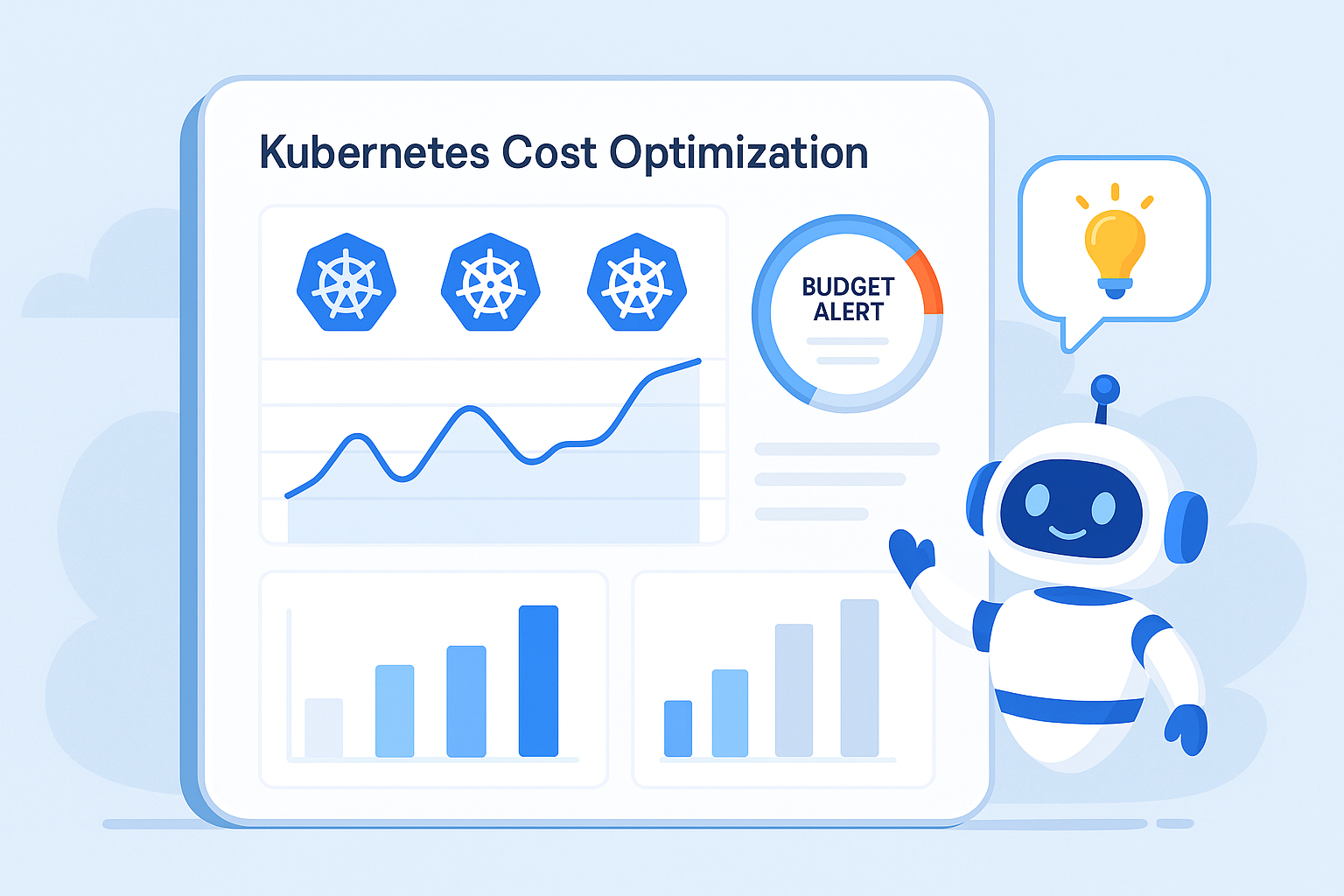
The bigger cost is inference. GitOps does not make model calls cheaper. Agent cost depends on token volume, retries, context size, and run frequency. Set per-task token and time budgets, cap retries, cache stable results, and use smaller models for routing. Add budget alerts and hard quotas before a runaway loop consumes a month of margin in an afternoon. With an API, track cost per successful task, not per request.
Rollback costs show up in retention. Old images, index snapshots, logs, and backups have a storage price. Keeping too little makes recovery slow or impossible. Define recovery targets for each agent, then retain only what those targets require.
Build versus buy comes down to labor. A managed service can be cheaper than dedicating an engineer to upgrades, backups, and high availability. Self-hosting offers more control and may be required for data residency, but it shifts patching and on-call work to you. Choose based on who will operate it, not list price.
Decisions to make before deployment
- Define the release unit: image digest, prompts, model version, index snapshot, tool policy, flags.
- Choose rollback: Git revert, rollout undo, or compensating actions.
- Set blast radius: canary percentage, analysis window, abort metrics.
- Separate schema migration, and test restore.
- Scope permissions, keep secrets out of Git, rehearse the kill switch.
Frequently asked questions
Can GitOps roll back an AI model’s behavior? Only for the parts you version. If model version, prompts, tools, and retrieval snapshot are pinned and recorded, reverting them can restore prior behavior. If a provider changes a model behind an alias, or the index changes outside the release process, GitOps cannot guarantee identical output.
Where should secrets live? In a dedicated secret manager, injected at runtime. Encrypted secrets in Git can work for small teams, but key management and rotation still matter. Base64 is not protection.
What should gate a canary? Leading indicators, not just uptime. Combine error rate and latency with invalid tool calls, duplicate actions, human escalations, and cost per task. Pick thresholds you can explain to a business owner.
What about non-deterministic output? You cannot make an LLM deterministic the way you make an image deterministic. You can make the surrounding system reproducible: fixed model versions, fixed prompts, recorded tool responses, seeded tests, and evaluation suites against a known dataset before promotion.
GitOps is valuable because agents are hard to reason about. It gives you one reviewed history, a repeatable apply step, and a rollback path you can practice. To map that to your stack, talk to Kubeify about your deployment and rollback design.